Friday, January 30, 2009

Credit Crisis: The end of Capitalism?

Further to the previous post, this will be on a more serious note.

Greed. 
If there was one word to sum the whole credit crunch up, that would be it.

I am not about to espouse overly academic notions on the abovementioned topic, but rather more "layman" views. (As layman as my brain allows anyway...) Before we start, let's take a step back in time to when Karl Marx, Father of Communism, was still alive.


Karl Marx, Das Kapital, wrote in 1867:

"Owners of capital will stimulate the working class to buy more and more of expensive goods, houses and technology, pushing them to take more and more expensive credits, until their debt becomes unbearable. The unpaid debt will lead to bankruptcy of banks, which will have to be nationalised, and the State will have to take the road which will eventually lead to communism..."

Isn't this interesting? That Capitalism, fuelled by greed, can actually stimulate a turning tide against itself and resurrect the old ghost of Communism which all but died about half a century back. BBC reported some time back that Karl Marx was gaining popularity in this present crisis.

What USA is doing now, whilst bailing out the big "un-faileable" companies, is extremely short-sighted. Most recessions undergo a normal period of decreasing demand of goods and services, followed by a gradual stabilization that brings about a bottoming out of the financial markets, and recovery follows soon after (see told you this is a layman article). Not this time.

Because of the interference in the markets, the US of A effectively ensures that it will have a long lingering problem of bad loans and lousy leaders that will be sitting around long after the actual crisis is over. Recovery will take an extremely long time, because companies which are not healthy are going to be surviving, barely, for an extended period of time.

And in a capitalistic world, we would all do well to know that it is always the survival of the fittest that brings about evolution of the species. If these dying humungous companies with bad management are allowed to linger past their prime, does not that cause an inbreeding of bad ideas (e.g. poor risk management, concept that government will always bail you out if you are big enough etc)?

Being a layman, I see things very simply. If you are sick and you need to puke, put your fingers into your mouth to induce vomiting. If you are afraid of spilling your guts out, you will only feel sick for a longer period of time. The same analogy can be applied to the state of the economy now. The government needs to decide to allow other institutions or corporations to buy the failures out instead of stepping in to interfere. Also, for the bailed out companies, the leaders NEED to go. It is extremely surprising and disturbing that 9 of 10 top honchos in the troubled companies that have been around since 2006 are STILL in their hot seats!

Short-term wise, there will be pain in doing so, and in this present climate, the pain will be intense and akin to extracting a bullet from your tummy. However, if you don’t do so, the “bullet” will cause the wound to fester, and you eventually die. Which do you choose?

Actually, both Communism and Capitalism concepts have their merits when executed in the way it was intended to. Unfortunately when you add in the human factor, things don’t always turn out the way they are intended to. For Communism, it conveniently ignores that laziness is a natural human trait, and for Capitalism, greed.

But well, that’s life. Nothing is perfect.
Neither is this article. I have left many gaping holes for you to poke at so that I can have a discussion with great minds.

Friday, January 16, 2009

A real letter from a boss to his employees

To All My Valued Employees,
 
There have been some rumblings around the office about the future of this company, and more specifically, your job. As you know, the economy has changed for the worse and presents many challenges. However, the good news is this: The economy doesn't pose a threat to your job.
 
What does threaten your job however, is the changing political landscape in this country. Of course, as your employer, I am forbidden to tell you whom to vote for -- it is against the law to discriminate based on political affiliation, Race, creed, religion, etc.
 
Please vote who you think will serve your Interests the best. However, let me tell you some little tidbits of fact which might help you decide what is in your best interest. First, while it is easy to spew rhetoric that casts employers against employees, you have to understand that for every business owner there is a back story.
 
This back story is often neglected and overshadowed by what you see and hear. Sure, you see me park my Mercedes outside. You've seen my big home at last years Christmas party. I'm sure all these flashy icons of luxury conjure up some idealized thoughts about my life. However, what you don't see is the back story.
 
I started this company 12 years ago. At that time, I lived in a 300 square foot studio apartment for 3 years. My entire living space was converted into an office so I could put forth 100% effort into building a company, which by the way, would eventually employ you.
 
My diet consisted of Ramen Pride noodles because every dollar I spent went back into this company. I drove a rusty Toyota Corolla with a defective transmission. I didn't have time to date. Often times, I stayed home on weekends, while my friends went out drinking and partying. In fact, I was married to my business -- hard work, discipline, and sacrifice.
 
Meanwhile, my friends got jobs. They worked 40 hours a week and made a modest $50K a year and spent every dime they earned. They drove flashy cars and lived in expensive homes and wore fancy designer clothes. Instead of hitting the Nordstrom's for the latest hot fashion item, I was trolling through the Goodwill store extracting any clothing item that didn't look like it was birthed in the 70's.
 
My friends refinanced their mortgages and lived a life of luxury. I, however, did not. I put my time, my money, and my life into a business with a vision that eventually, some day, I too, will be able to afford these luxuries my friends supposedly had.
 
So, while you physically arrive at the office at 9am, mentally check in at about noon, and then leave at 5pm, I don't. There is no "off" button For me. When you leave the office, you are done and you have a weekend all to yourself. I unfortunately do not have the freedom. I eat, ****, and breathe this company every minute of the day. There is no rest. There is no weekend. There is no happy hour. Every day this business is attached to me like a 1 day old baby.
 
You, of course, only see the fruits of that garden -- the nice house, the Mercedes, the vacations... You never realize the back story and the sacrifices I've made. Now, the economy is falling apart and I, the guy that made all the right decisions and saved his money, have to bail-out all the people who didn't.
 
The people that overspent their paychecks suddenly feel entitled to the same luxuries that I earned and sacrificed a decade of my life for. Yes, business ownership has is benefits but the price I've paid is steep and not without wounds. Unfortunately, the cost of running this business, and employing you, is starting to eclipse the threshold of marginal benefit and let me tell you why:
 
I am being taxed to death and the government thinks I don't pay enough. I have state taxes. Federal taxes. Property taxes. Sales and use taxes. Payroll taxes. Workers compensation taxes. Unemployment taxes. Taxes on taxes. I have to hire a tax man to manage all these taxes and then guess what? I have to pay taxes for employing him. Government mandates and regulations and all the accounting that goes with it, now occupy most of my time. On Oct 15th, I wrote a check to the US Treasury for $288,000 for quarterly taxes. You know what my "stimulus" check was? Zero. Nada. Zilch.
 
The question I have is this: Who is stimulating the economy? Me, the guy who has provided 14 people good paying jobs and serves over 2,200,000 people per year with a flourishing business? Or, the single mother sitting at home pregnant with her fourth child waiting for her next welfare check?
 
Obviously, government feels the latter is the economic stimulus of this country. The fact is, if I deducted (Read: Stole) 50% of your paycheck you'd quit and you wouldn't work here. I mean, why should you? That's nuts. Who wants to get rewarded only 50% of their hard work? Well, I agree which is why your job is in jeopardy. Here is what many of you don't understand; to stimulate the economy you need to stimulate what runs the economy. Had suddenly government mandated to me that I didn't need to pay taxes, guess what? Instead of depositing that $288,000 into the Washington black-hole, I would have spent it, hired more employees, and generated substantial economic growth. My employees would have enjoyed the wealth of that tax cut in the form of promotions and better salaries. But you can forget it now.
 
When you have a comatose man on the verge of death, you don't defibrillate and shock his thumb thinking that will bring him back to life, do you? Or, do you defibrillate his heart? Business is at the heart of America and always has been. To restart it, you must stimulate it, not kill it. Suddenly, the power brokers in Washington believe the mud of America are the essential drivers of the American economic engine.
 
Nothing could be further from the truth and this is the type of change you can keep. So where am I going with all this? It's quite simple. If any new taxes are levied on me, or my company, my reaction will be swift and simple. I fire you. I fire your co-workers. You can then plead with the government to pay for your mortgage, your SUV, and your child's future. Frankly, it isn't my problem any more. Then, I will close this company down, move to another country, and retire.
 
You see, I'm done. I'm done with a country that penalizes the productive and gives to the unproductive. My motivation to work and to provide jobs will be destroyed, and with it, will be my citizenship.
 
While tax cuts to 95% of America sounds great on paper, don't forget the backstory: If there is no job, there is no income to tax. A tax cut on zero dollars is zero. So, when you make decision to vote, ask yourself, who understands the economics of business ownership and who doesn't? Whose policies will endanger your job? Answer those questions and you should know who might be the one capable of saving your job. While the media wants to tell you "It's the economy Stupid" I'm telling you it isn't.
 
If you lose your job, it won't be at the hands of the economy; it will be at the hands of a political hurricane that swept through this country, steamrolled the Constitution, and will have changed its landscape forever. If that happens, you can find me in South Caribbean sitting on a beach, retired, and with no employees to worry about.
 
Signed, 
Your boss

Wednesday, December 24, 2008

Smile! :)

Merry Xmas to all and Happy New Year!

Tuesday, December 2, 2008

Fix-its for Singapore's Public Transport system

In its push to achieve a seamless and reliable public transport system, the Land Transport Authority (LTA) has helped implement / mandate (with the public transport operators) several measures.


They include:

  1. more regular bus services;
  2. more regular MRT services;
  3. more regular MRT services during lunch hours for workers in the city;
  4. increased transfer rebates between buses / trains, making it cheaper for commuters to transfer between ;
  5. more bus lanes;
  6. all-day bus lanes within the City area;
  7. increasing the number of bus lane operation hours;
  8. ERP gantries to stem out congestion in the more crowded roads;
  9. increased maintenance costs of private vehicle ownership so that people turn to public transport (I’m just putting this in tongue-in-cheek);
  10. increased congestion on the roads so that private transport speeds are now equalized with public transport (again, tongue-in-cheek)


However, looking at the above list, which of the measures have really succeeded? By success, I mean, which of the measures have been felt by the common folk on the ground?

I leave it to the people who read this to think it through.


My own opinion is that while SMRT’s efforts are getting more recognized by the man-in-the-street (judging from its increase in ridership) I am not trying to give a pat on the back to them here. Its response to the increase in its ridership has been disappointing to say the least. Anyone who takes the trains now would know what I am talking about.


  1. The waiting times are too long - and I am not even talking about off-peak hours. Even during the 7-8pm period, the waiting time can be up to 7mins! Is this reasonable?
  2. The waiting times displayed on the signboards are not accurate. Ever felt that the 3 mins shown on the signboard feels longer than just 3 mins? Is LTA going to force SMRT to do anything about it, or the top officials in the ministry, regulatory agencies and transport companies just don’t take rides everyday to share the common man’s misery? (Hello, wake up please!)

Finland’s bus timings (at least in Oulu) are almost impeccable. They have a table on the internet that states when buses come (e.g. 5.13pm, 5.49pm etc) and they do arrive within the minute! Probably because winter there is very cold and people do not expect to wait too long in the cold? Or maybe, an operator that really cares?

  1. The trains are packed to the door. Again, I am not griping just about the peak hours. I just took a train last Sunday at around noon, and it was so packed that I think at the most 2 more people could squeeze in from my door! I would like the CEO of SMRT to take her own trains to see what kind of policies she is implementing is really working the way she wants? Miss Saw, any comments? Or you’re only bothered about your shareholders?


I would like to suggest some improvements for the transport companies:

  1. Bus companies should look into having mini buses for existing popular routes and increasing regularity of these services even for non-peak hours.

Having said that, I understand bus companies have to balance their operational costs versus profits. However, my opinion is that while it will hurt operational profit in the short term, the availability of regular bus services will, over time, ingrain in people the idea that driving is not much better off, since regular bus services (say every 5-10 mins) can get them to their destination in a comparably quick time as well. Comfort is not compromised as well, as regular bus services would help ensure most people would get seats on their rides. This in turn, may aid the bus companies in their cause to raise fees – I would be more than willing to support them if I can see something substantial, not easing 99% ridership to 92% - that’s bullshit to me.

  1. If (1) cannot be done by the existing bus operators, the government should “liberalize” the markets to force the incumbents to work out something viable. Introduce a few more operators and give some routes to them, and force an artificial oligopoly of sorts. This will definitely help SBS and SMRT to wake up to the fact that someone out there can think better than them. At least it helped SingTel to streamline operations, and lower phone ownership costs to consumers.
  2. There has been some hoo-ha over SMRT removing seats in some cabins for newer trains to ensure that their trains can pack in more people. While there is nothing wrong with this commercial decision, commuters would naturally feel indignant? What if I told u, in order to make your existing car a seven-seater, I remove all the seats and ask u to stand? While the analogy may not be very appropriate, I hope it drives home a point.

SMRT can take a leaf out of the Japan Railway trains. Their seats can be folded up during the morning and evening peak hours to make room for more people to be “packed” into the trains. I guess the rationale being old or handicapped people are less likely to take public transport during these hours. When it is during off-peak hours, the seats can be unlocked and people can then get a comfortable ride. For people who prefer to sit and don’t need to take the train during peak hours would then also avoid taking the trains then. Sounds like a good plan, right?


I hope that SMRT, TIBS, and ComfortDelgro can sit up and take notice of the pains felt by the people taking their transport. In your cause to fight for higher fares, do not compare yourselves to other transport systems like those in Finland, Japan etc. You have NO REASON to charge like they do simply because you are not up to standard yet.

Saturday, November 15, 2008

The Average Investor mentality

Look at this chart, and think to yourself, isn't this why u lost $ in the market today?

Moral of the story: no guts, no glory.
But yr risk better be calculated properly!

Tuesday, October 21, 2008

Credit crisis jokes

Amidst the doom and gloom, something to lighten up.........


A trader: "This is worse than a divorce. I've lost half my net worth and I still have a wife." 


President Bush said clients shouldn't be concerned by all these bank closings. 
If the bank is closed, you just use the ATM, he said. 


George Bush said that he is saddened to hear about the demise of Lehman 
brothers. His thoughts at this time go out to their mother as losing one 
son is hard but losing two is a tragedy. 


The problem with investment bank balance sheets is that on the left side 
nothing is right and on the right side nothing is left. 


There are 30 billion prime numbers below 700 billion. 
The rest are all subprime. 


How do you define optimism? 
A banker who irons 5 shirts on a Sunday. 


What do you call 12 investment bankers at the bottom of the ocean? 
A good start. 


Why are all MBAs going back to school? 
To ask for their money back. 


For Geography students: What's the capital of Iceland? 
Answer: About Three Pounds Fifty... 


If you want to gamble, go to Las Vegas. 
If you want to trade in derivatives, God bless you. 


Whats the difference between a guy who just lost everything in Vegas and an investment banker? 
A tie. 


Whats the difference between a bond and a bond trader? 
A bond matures. 


Lehman have changed their recommendation on Lehman from hold to sell. 

Monday, October 6, 2008

Guaranteed

What does this word mean to you?

After this crisis, not much anymore. Capital guaranteed, funds protected blah blah. A whole load of financial bullshit jargon that is attempted at soothing your worries when purchasing complex financial instruments that you know as much as a first grader knows about Einstein's Theory of Relativity.

Guaranteed. Those were the times, where capital guaranteed contracts were sold to unsuspecting customers and predicated on the fact that big-name firms like Lehman and AIG would never ever need to worry about Chapter 11. Looking at Lehman's case in point, it was only part of a handful of US financial firms that weathered through a century of existence*. And yet, it couldn't take the onslaught of (what some say was) opportunistic short-selling and inadequate and untimely government intervention. Maybe, more importantly, it couldn't control greed, one of the fundamental sins of man.

On Wall Street, greed prevailed. Greed to earn ever more "instant cash" by taking on more and higher risks, greed to earn more commission by coming up with "innovative" products which, ironically, were doomed to fail. Horror stories emerged on Bloomberg about how some products were structured such that it would take 10 years of increased growth to earn the interest that was promised. How in the world did such products make it to market? Who would even pay one cent for such a product if this were made known?

The government should protect the "fraudulent" use of this word, especially on financial instruments, as it touches on an issue dear to all people's hearts. It is really saddening to hear of old people's retirement funds suddenly just wiped out in an instant without warning.

"Buyer beware" clauses should be removed so that the banks will sufficiently educate their sales personnel not to mislead customers into parting with their cash for a trashy product. Alternatively, these clauses could be in place if a proper course for the man-in-the-street were conducted, with proper certification from the authorities. Granted, this would lead to more regulation and red tape, but financial products are not necessities of life and can thus be done without. For that extra bit of profits, banks would need to work harder to give value to their customers.

In the end, governments might not want to take on that kind of risk because it simply puts the onus on them to be extra vigilant themselves. Especially in the US where class action suits are the norm, things may not be as simple as they first looked like.

*Taken from Bloomberg: Fuld Blames Lehman's Fall on Rumors, `Storm of Fear'
[
http://bloomberg.com/apps/news?pid=20601087&sid=a8a9vKTJR7KY&refer=home]

Monday, September 8, 2008

Drink driving

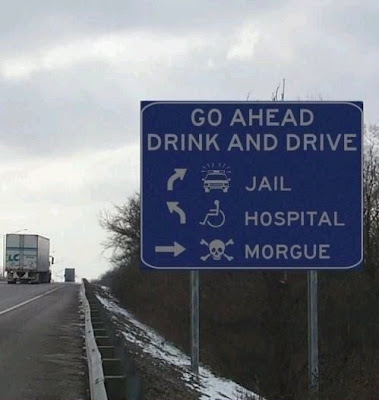
The Singapore Govt has always been chided for being too serious, therefore instead of having sombre ads like a car skidding off the road and the whole TV screen splashed with red, it could consider having signboards like these.


Cheap, good, and probably effective - people tend to remember funny things more than specially made "horror clips". Helps to lighten the mood when driving along the road too, and more importantly, if SHIT does HAPPEN, you know the way to bring the injured to hospital and turn yourself in?

Sunday, July 20, 2008

Just for laughs - M.A.H.A.T.H.I.R

When Dr. Mahathir was Prime Minister of Malaysia...


One lousy day in the middle of the economic crisis, PM Mahathir was feeling extremely frustrated and wondering how a neighboring country can be doing better than Malaysia.

One of his aides said, I heard that the leaders consult Feng Shui masters to ensure prosperity for the country. Dr Mahathir thought if that was the case, Malaysia Bomoh also can, and went to seek the top bomoh's advice in the country.

After reviewing the case, the bomoh told Dr M that there were 2 things that he must do :

Bomoh : Step 1. You must blame the crisis on SOROS for everything.
Dr M : But Why ?
Bomoh: Because SOROS stands for 'Speculate On Ringgit Or Stocks'.
You must blame him, and look at ways to control the ringgit and stock market.
Bomoh : Step 2 - You must get rid of ANWAR.
Dr M: What! Why him ?
Bomoh: Because ANWAR stands for 'A Nation Without Any Ringgit'.
Dr M: But how? This is most difficult to do, he is popular with the people.
Bomoh : Aiyoh, you bodoh lah! Look at your name, MAHATHIR.
Make Anwar Homosexual And Then Highlight It Repeatedly!


The latest according to the trend...
M.A.H.A.T.H.I.R is the new acronymn for...............................


Must Always Hantam Abdullah Till He Is Removed

Sunday, July 13, 2008

How to have your cake and eat it

Let's talk about how to raise the cost of car ownership, and at the same time raise public transport fares, AND how to make the public swallow the bitter pill.

Impossible in other countries? Not in Singapore - adidas' famous (or infamous) slogan applies - impossible...... is nothing.

-------------


The ERP (Electronic Road Pricing) system is an ingenious idea. Whoever came up with this idea should have the Nobel Prize (Economics).

I mean, seriously. Why have toll booths? Why pay people to collect money, when you can have it automated? When the system is faulty, there is no trouble for the government at all - the onus is on the driver to prove so.

Cheap to build, and the gantry can be up in days (probably 1 month or less if you throw in software configuration testing etc.) Next, you can start charging motorists based on a whim and fancy - "oh, traffic speeds are below 45kmh." And wait, motorists only need to be given a week's notice.

No alternative routes need to be suggested, Singaporean drivers don't need nannies to teach them how to drive, yeah? They can always use the numerous sites on the Internet to tell them how to plan their routes, and there's even one which will tell u how much your intended route costs (only ERP of course, petrol not included).

The government's rebuttals are getting tired of late. "Speeds are falling, we have to arrest the trend, before it rapidly degenerates and investors get put off into ploughing money in Singapore Inc."
Fear Factor, anyone?

It conveniently forgets the investors and its citizens ALREADY in Singapore who find the escalating costs going out of hand, or does the SG government do a calculated risk that Singaporeans are just too settled in to move out of this tiny island? Even if so, what about the existing investors/ foreign talent etc?

And the latest news, taxi drivers are finding it expensive to drive into the CBD because of ERP, so many will choose to stay away. So now commuters who need a cab in the CBD need to call for one! What next?

-------------------

The next bone I have to pick is the rising public transport fares. The government recently announced a change in the public transport fare structure that would be distance-based, rather than depending on how many times u switch buses/trains. That is reason to cheer, until you read on and realize that it is actually a facade for something more scheming - to raise fares for 6 out of 10 people who actually have direct buses from source to destination. What's more, transport companies are encouraged to scrap direct routes because they are "less efficient".

FARE HIKE, then no more direct routes? What in the world is the government thinking? When u factor in a journey's time, please also factor in waiting time. It is NOT fair at all to just compare travelling time, (because if you didn't already know!!!) waiting time can take up a significant portion of the total time u take to get from place to place! I wonder just how far removed our ministers are from the ground. Seriously!

Ministers and top management of LTA, please take the public transport at least once a week. The condition here is, you are not allowed to inform the bus companies when you want to take it. You are also not allowed to tell them where you are taking it from, or where you are going to. In brief, you should act as the man on the street for a day a week, so you can feel our pain.

If the government wants to encourage people to use public transport, then for heaven's sake, please improve the regularity, particularly during peak hours! Reasons like existing infrastructure not being able to support more regular train schedules are NOT acceptable. If the people at the top can for one moment stop running the country like a company, they might even have the heart and clarity to see the common man's problems. Or is it too cloudy on top to see the ground below? Or maybe, just maybe, they choose to assume these problems don't exist. After all, it's easy to do that when you have a nice comfy car and a motorcade to whisk you around wherever you need to go. And ERP is paid for by the government!

---------------

High fliers, time to lower yr cruising level. Lower yourselves for one moment, live and breathe the shit we're facing now for some time, before you go back up to your perch and "continue looking at the big picture".